Recording, Film and Broadcast Consoles
Message Board - Recording Consoles General Discussion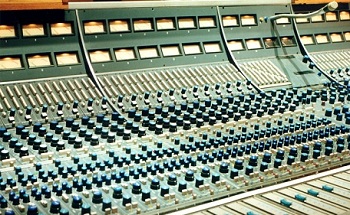
The design of today’s sophisticated recording console is quite complex, due to the multiplicity of devices associated with the mixing network, such as dynamics processing and automation. Many will recall when paralleled battery rheostats were used as mixer controls for broadcasting and motion picture sound recording, and will view the modern console as an outgrowth of the basic principles applied at the time.
With miniaturization, many components are now included in the mixer network, rather than at a remote position. Printed circuit plug-in designed components facilitate replacement in the event of failure. Several different types on analogue solid-state and vacuum tube mixers exist along with solid-state digital mixing desks.
The mixing console can be a complicated piece of equipment but, in its respective fundamental electronic core, its main function is relatively simple. At minimum a mixer consists of a resistive network, which may consist of a passive combining or active combining network, designed to provide a means of combining two or more separate audio sources into one, or more, composite signal(s). The layout of the console may be of either a split design or, the ever popular, in-line design. Below you will discover a variety of diverse, unique and in some cases atypical recording consoles
Foundational text inspired by Howard M. Tremaine's, "Audio Cyclopedia" and "Audio Engineering know it all".
AMEK Console(s)AMEK 9098i Series Recording Console |
Electrodyne Console(s) |
Harrison Console(s) |
Helios Electronics Consoles |
Langevin Console(s) |
MCI ConsolesMCI JH-400 Series Console |
NEVE ConsolesNeve A646 Recording Console |
Olive Console(s) |
Trident ConsolesTrident Series 65 Console |
Loading
Recording and Film Consoles
Do you have content, to add, about Recording and Film Consoles or associated topics? Please feel free to Share it, here!
What other Visitors have said about Recording and Film Consoles
Click below to see contributions from other visitors to this page...
Auditronics 
Auditronics was a manufacturer of recording consoles made in Memphis, Tennessee.
The original premiere console they introduced, the 501 also dubbed …
American Studio Custom Universal Audio Console
This is a picture of the recording console from American Sound Studios, Memphis Tennessee. It featured Universal Audio 610 modules, and was used between …
Trident Series 80B Recording Console
The "Series 80" has been designed as a direct result of demand from studio owners for a recording console that offers the highest technical specifications, …
Audio Designs and Mfg. / aka ADM Technology Not rated yet
ADM delivered the first film production console to Glenn Glen Hollywood in 1981. This was the industries first digitally controlled analog console. Like …
National Recording Milwaukee's RCA Consoles BC-3 BC-5 Not rated yet
We went to great lengths to restore and modify these two consoles for doing 50's style recording straight to Ampex full track 350.
MCI & Harrison Not rated yet
David Harrison developed the world's first "in-line" console where the output channel was located above the input channel. This was also the first console …
Console designed and built by Sandy Lamont. Lamont Audio LLC Not rated yet
This console designed and built by Sandy Lamont features 990c amps and opa2604 op amps. It has a 4 band fully parametric eq section and a dynamics section …
Other notable consoles Not rated yet
Sphere of Chatsworth California. Created by Don McLaughlin. These were incredible sounding, lovely high-end consoles. Mostly all discrete transistor where …
Return from Recording, Film and Broadcast Consoles to History of Recording - Homepage |


